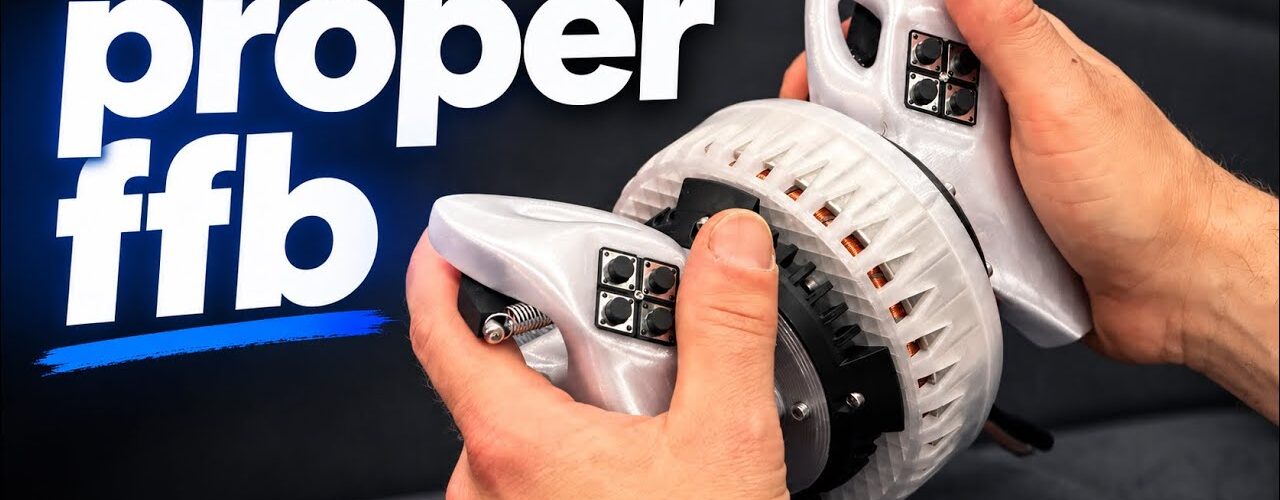
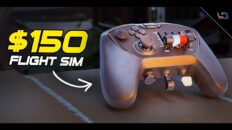
One of my favourite discoveries at the 2026 Sim Racing Expo in Frankfurt was a largely 3D printed controller that doesn’t even have an official product name yet. It looks unusual, it’s still a prototype, and it gave me one of the most enjoyable surprises of the show.
The developer is Emmanuel, whose nickname is Twisty. Until there’s an official name, I’m calling the controller the Twisty too. The prototype weighs approximately 900 grams.
You steer by twisting the two halves relative to each other, with triggers for throttle and brake and buttons for shifting. But the reason I’m excited is what happens when the simulator pushes back: this thing delivers proper steering force feedback through your hands.
The important part is the force feedback
After I shared the video, plenty of people mentioned Namco’s neGcon and Microsoft’s SideWinder Dual Strike. I understand the comparison. Twisting controllers have existed for decades, and I’m not suggesting Emmanuel invented twisting as an input method.
Neither the neGcon nor the Dual Strike provided the steering force feedback I experienced here. To be precise, I mean the Dual Strike: Microsoft also made force feedback wheels and joysticks under the SideWinder name.
What interests me is the combination of a custom-built motor, described as using patented technology, and an OpenFFBoard providing the force feedback interface. OpenFFBoard is an existing open-source project; the novelty I’m highlighting is its integration with this motor technology in a handheld racing controller.
That distinction matters. A controller vibrating over a kerb can tell you something happened. Steering force feedback can also act against your steering input, changing the forces you feel as you drive. That interaction is central to why I enjoy sim racing with a wheel, and experiencing it in this format was the surprise.
Familiar feedback through an unfamiliar controller
As someone who races with force feedback, I found the experience very intuitive and pleasant. The movements looked different, but the information coming through my hands felt familiar.
I could feel the steering load changing through corners, pick up on the car becoming unsettled, and respond to slides. Catching those slides was particularly enjoyable. I wasn’t simply watching the screen and trying to guess what steering correction to make; I had useful physical feedback to work with.
Across my time with it, I tried a Caterham and what I believed was a Dallara, on different simulators. This wasn’t just one carefully chosen, easy-to-drive car making the controller look good.
It’s difficult to communicate that feeling in a video. You can see the controller moving, but you can’t feel the forces that helped those movements make sense to me.
There is still work to do
The steering sensitivity was too high in the demonstration. I didn’t have access to adjust the settings, and I passed that feedback on.
Looking back, my biggest regret is that I didn’t film more of myself driving in anger: hitting apexes, braking hard and properly enjoying what this controller could do. I did drive it that way, and it was great fun. I should have captured that experience so you could see why I was so enthusiastic.
The video was a summary of my feelings about the controller, rather than footage that properly showed me enjoying the driving experience. I was explaining what impressed me while demonstrating the controls, and I didn’t give you enough of the focused driving that would have helped communicate how good it felt. That’s on me, and I regret not filming it.
For context, this was filmed at the 2026 Sim Racing Expo in Frankfurt. I usually don’t record standalone video content at the expo outside of my livestream walkthrough. This controller made enough of an impression that I wanted to stop and share it, but I wish I’d also recorded the harder driving that led to those feelings.
I’d like to be able to limit the overall travel on both the throttle and brake, with independently adjustable travel limits so I could set each trigger to my preference. The prototype uses the same mechanism for both, but I’d also like a firmer brake feel, potentially using an elastomer stack.
Holding a consistent brake input could be tricky, especially while operating a nearby shift button. Shorter travel and more progressive resistance could help make braking more controlled and repeatable.
Those are the details I’d want to explore with more time at home. This was an encouraging hands-on experience, rather than a long-term test of comfort, durability or competitive pace.
An update from the inventor: modular controls
Since filming, Emmanuel has shared some of the directions he’s considering for the controls. His idea is to make the brake, throttle and shifting controls as modular segments, allowing customers to choose the setup that suits them.
Possibilities he mentioned include magnets instead of springs and load-cell sensing based on force rather than trigger travel. These are ideas under consideration, rather than confirmed specifications for a finished product. I’d be very interested to try those options alongside the adjustable travel limits I’d like on both throttle and brake.
In the YouTube discussion, posting as @Voxters, he also explained that he’s considering a modular approach to accommodate both experienced and casual users, with choices between magnets and springs, or travel-based and force-based input.
“Thanks to the OpenFFBoard everything is super flexible!”
Emmanuel (@Voxters), in the YouTube comments
He also identified Gran Turismo as the inspiration for making Twisty, reporting that he had resolved some issues with PCSX2 and was enjoying Gran Turismo 4. That’s his experience with an emulator setup, rather than confirmation of native PlayStation console support.
A different route into sim racing
Accessibility is one of the most exciting possibilities here. Having steering, throttle, brake and shifting in your hands could offer another option for people who cannot use conventional pedals.
Wheel-mounted analogue paddles and other adapted controls already provide alternatives. This controller could add another approach, particularly where positioning or storing a wheel setup is difficult. Whether it suits someone will depend on their individual requirements.
There’s also an appeal for people who simply don’t have space for a rig. I can imagine someone wanting meaningful force feedback without needing to set up a wheel and pedals every time they drive.
I’m not about to throw out my rig. I enjoy using equipment that resembles the controls in the car. But a different input device can still be enjoyable and useful, especially when it communicates information I already know how to interpret.
Could the technology work for motorcycle simulation?
The motor also got me thinking about motorcycle controls. A purpose-built device with force feedback might offer interesting ways to communicate steering forces and support countersteering inputs.
There’s also an encouraging update from Emmanuel on that front: he tells me Dakar Desert Rally has force feedback for its motorcycles and that it “feels super cool!” I haven’t tried that combination myself, but it gives me another reason to want more time with the controller.
That doesn’t establish how accurately a particular setup reproduces motorcycle countersteering, or confirm support across other bike games. Suitable software support and a control system designed around motorcycle behaviour still matter. But I’d love to explore what this motor technology could offer in a purpose-built motorcycle controller.
Would I buy one?
In the video, I suggested €500 or more as a possible price for an initial product. That was my own estimate, not an announced price or a quote from the developer.
At that sort of money, I would still be interested. The value for me would come from having useful sim racing force feedback in a compact device I could use without my usual setup.
There are unanswered questions about a finished product, and I’d want proper time with one before judging its ultimate capabilities. But I left the demonstration wanting more time behind those controls.
Twisting caught people’s attention. The force feedback is what made me want one. Emmanuel, this is class. I really hope it reaches the people who could enjoy it most.


Add comment