
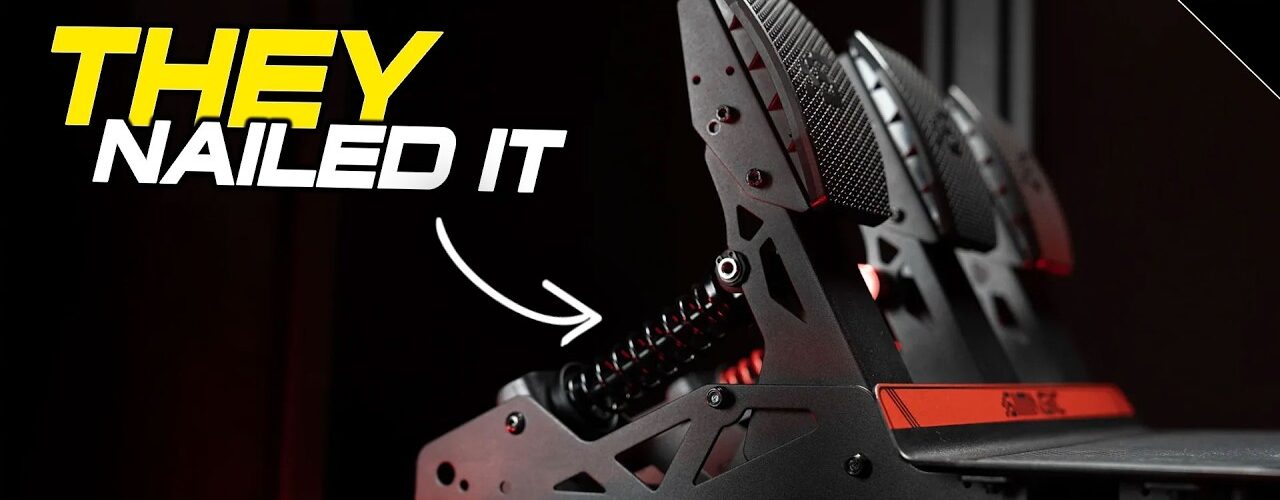
The Simagic P700 pedals surprised me. After roughly six to eight weeks of using them for essentially all of my sim racing across a variety of titles, they have gone straight into my top recommendations for entry-level pedals. There were no compatibility problems, no reliability problems and, most importantly, the brake is far better than I expected at this price.
| Logo | Brands | Reseller | Discount Code | Link | Ships to | Locations |
|---|---|---|---|---|---|---|
 | Fanatec | Fanatec USA | https://laurencedusoswa.com/a/FANATEC-USA | America | Beverly Hills, California, USA | |
| Fanatec | Fanatec EU | https://laurencedusoswa.com/a/FANATEC-EU | EU | Landshut, Germany | |
| Fanatec | Fanatec Australia | https://laurencedusoswa.com/a/FANATEC-OZ | Australia | New South Wales, Australia | |
| Fanatec | Fanatec Japan | https://laurencedusoswa.com/a/FANATEC-JP | Japan | Tokyo, Japan | |
 | BDH, Conspit, Cube Controls, D-BOX, Heusinkveld, Logitech, MOZA, Pimax, Qubic System, Rexing, Simagic, Simucube, Trak Racer, VNM | Trak Racer USA | https://laurencedusoswa.com/a/TRAK-RACER-USA | America | Austin, Texas, USA | |
| BDH, Conspit, Cube Controls, D-BOX, Heusinkveld, Pimax, Qubic System, Rexing, Simagic, Simucube, Trak Racer, VNM | Trak Racer UK | https://laurencedusoswa.com/a/TRAK-RACER-UK | UK | Hertfordshire, England, UK | |
| BDH, Conspit, Cube Controls, D-BOX, Heusinkveld, MOZA, Pimax, Qubic System, Rexing, Simagic, Simucube, Trak Racer, VNM | Trak Racer EU | https://laurencedusoswa.com/a/TRAK-RACER-EU | EU | Venlo, The Netherlands | |
| BDH, BWT Alpine Formula One Team, Conspit, Cube Controls, D-BOX, Heusinkveld, Hot Wheels, Pimax, Qubic System, Rexing, Simagic, Simucube, Trak Racer, VNM | Trak Racer Australia | https://laurencedusoswa.com/a/TRAK-RACER-OZ | Australia | Victoria, Australia | |
 | Asetek | Asetek Global | 5% off with coupon code 'LD' | https://laurencedusoswa.com/a/ASETEK-GLOBAL | Global | Florida, USA. Aalborg, Denmark |
| Asetek | Asetek USA | 5% off with coupon code 'LD' | https://laurencedusoswa.com/a/ASETEK-USA | America | Florida, USA |
| Asetek | Asetek EU | 5% off with coupon code 'LD' | https://laurencedusoswa.com/a/ASETEK-EU | EU | Aalborg, Denmark |
 | Simagic | Simagic Direct | 3% off with coupon code 'LD' | https://laurencedusoswa.com/a/SIMAGIC | Global | Shenzhen, China, Asia |
 | Fanatec, GT Omega, HORI, Logitech G, MOZA Racing, Next Level Racing, Playseat, PXN, Thrustmaster, DIWANGUS | Amazon Global (will bring you to your local amazon store automatically) | https://laurencedusoswa.com/a/AMAZON | Global | ||
 | Apex Sim Racing, Cube Controls, D-BOX, Elgato, MOZA Racing, Pimax, Sabelt Sim Racing, Simagic, Simnet Racing, Simucube | Apex Sim Racing | 5% off with coupon code 'LD' | https://laurencedusoswa.com/a/APEX-SIM-RACING | Global | New Jersey, USA |
 | Advanced SimRacing, Ascher Racing, Base Performance Simulators, BavarianSimTec, BDH Race Sim Hardware, ButtKicker, Cube Controls, Daniel Newman Racing, D-BOX Technologies, Delta Sim-Tech, Gomez Sim Industries, Heusinkveld, IgnitiON Controls, Logitech, Max Papis Innovations, MME Motorsport, MOZA Racing, Novus Racing Simulators, P1Sim, Playseat, Precision Sim Engineering, Qubic System, Simucube, Sparco, Thrustmaster, Vero Motion, VNM Simulation, VPG Sim | Advanced Sim Racing | 5% off with code LDUSOSWAFIVE | https://laurencedusoswa.com/a/ASR | Global | Montreal, Canada |
 | Ascher Racing, ASUS, Base Performance Simulators, BDH Race Sim Hardware, ButtKicker, Cobra, Cube Controls, EPOS, Fanatec, Gigabyte, Go-Race, Gomez Sim Industries (GSI), Heusinkveld Engineering, ImSim, MME SimSport, MOZA, OBP, O-Rouge, Overclockers, Qubic System, Racelogic, Rexing, Sabelt Sim Racing, Samsung, Simucube, Simtag, Simtrecs, Sparco, Trak Racer, VPG Sim | Demon Tweeks | https://laurencedusoswa.com/a/DEMON-TWEEKS | Global | Wrexham, Wales, UK | |
 | bruzzi, ButtKicker, Conspit, Marina Racewear, MOZA Flight, MOZA Racing, Next Level Racing, Pro Simrig, Qubic System, Racing Sims, Sim Did, Simagic, Simetik, Simforge, Soelpec, Vero Motion | Abruzzi | https://laurencedusoswa.com/a/ABRUZZI | UK, EU | East-Sussex, England, UK | |
 | Streamlabs | Streamlabs | https://laurencedusoswa.com/a/STREAMLABS | Global | ||
| Restream | Restream | https://laurencedusoswa.com/a/RESTREAM | Global | |||
 | iRacing | iRacing | https://laurencedusoswa.com/a/IRACING | Global | Chelmsford, Massachusetts, USA | |
 | Coach Dave Delta | Coach Dave Academy | https://laurencedusoswa.com/a/CDA | Global | London, England, UK | |
 | Soelpec | Soelpec | https://laurencedusoswa.com/a/SOELPEC | Global | Istanbul, Turkey | |
 | Moza | Moza UK | https://laurencedusoswa.com/a/MOZA-UK | United Kingdom | UK | |
| Moza | Moza US | https://laurencedusoswa.com/a/MOZA-US | North & South America | USA | |
| Moza | Moza EU | https://laurencedusoswa.com/a/MOZA-EU | Global | Europe | |
| Moza | Moza Direct | https://laurencedusoswa.com/a/MOZA | Global | Shenzhen, China, Asia | |
 | Cobra, PRO SIMRIG, Qubic System, SIMAGIC, Sparco | RaceAnywhere | https://laurencedusoswa.com/a/RACE-ANYWHERE | UK, EU | Northamptonshire, UK | |
 | Grid Engineering, Sim-Lab, Sparco | Sim-Lab Direct | https://laurencedusoswa.com/a/SIM-LAB | Global | Tholen, The Netherlands, EU | |
 | Cammus | Cammus Direct | 5% off with code LDCAMMUS | https://laurencedusoswa.com/a/CAMMUS | Global | China, Asia |
 | Buttkicker | Buttkicker Direct | https://laurencedusoswa.com/a/BUTTKICKER | Global | Ohio, USA | |
 | Apex Sim Racing, Asetek SimSports, Gomez Sim Industries, Next Level Racing, SimSportGadget, Simtrecs, Simucube | SimRaceCity | 5% off with promocode: potato-nation | https://laurencedusoswa.com/a/SRC | USA | Fort Worth, Texas, USA |
 | Extreme Simracing, Simagic, D-BOX, DBOX | Extreme Simracing | https://laurencedusoswa.com/a/EXTREME-SIMRACING | America | Maringá, Paraná, Brazil | |
 | Ascher Racing, BavarianSimTec, SimRacingBay, Simucube | SimRacingBay | https://laurencedusoswa.com/a/SIMRACINGBAY | Global | Slovenia, EU | |
 | Simforge Engineering | Simforge Engineering | https://laurencedusoswa.com/a/SIMFORGE | Global | Chennai, India, ASIA | |
 | Website Hosting | HostGator | https://laurencedusoswa.com/a/HOST-GATOR | Global | USA | |
| RacGTing Racing Cockpits | RacGTing | https://laurencedusoswa.com/a/RACGTING | Global | Asia | ||
 | Getail Design | Getail Design | 5% off with coupon code 'LD' | https://laurencedusoswa.com/a/GETAIL | Global | Bergamo, Italy, EU |
 | Pimax | Pimax EU | https://laurencedusoswa.com/a/PIMAX-EU | EU | EU | |
| Pimax | Pimax | https://LaurenceDusoswa.com/a/PIMAX | Global | Shanghai , China | |
 | Asetek, Cube Controls, Fanatec, Sim Lab, Simagic | IRL Motorsports | https://laurencedusoswa.com/a/IRL-MOTORSPORTS | EU, UK | Dublin, Ireland | |
 | BDH | BDH Sim Hardware | https://laurencedusoswa.com/a/BDH | Global | Pocklington, York, UK | |
 | BDH, CAMMUS, Conspit, DOF Reality, Fanatec, Heusinkveld, MOZA Racing, PXN, Qubic System, Race Sim, Simnet Racing | RACESIM UK | 5% off with coupon code 'LD' | https://laurencedusoswa.com/a/RACESIMUK | UK, EU | London, UK |
 | Asetek SimSports, Conspit, Corbeau, Cube Controls, DOF Reality, Fanatec, Gomez Sim Industries (GSI), Heusinkveld, Leoxz, Moza, Sabelt, SIM HQ, Sim-Lab, Simagic, SRP, VRS | Simpatico Sim Shop | 5% off with coupon code 'POTATONATION' | https://laurencedusoswa.com/a/SIMPATICO | USA, Canada | Jacksonville FL, USA |
 | Conspit | iracesimulators | 10% off with code 'LD' | https://laurencedusoswa.com/a/IRACESIMULATORS | EU | Dublin, Ireland |
 | Bavarian Sim Tec | Bavarian Sim Tec | 5% off with coupon code LAURENCE-DUSOSWA | https://laurencedusoswa.com/a/BST | GLOBAL | Bavaria, Germany |
 | Advanced Sim Racing, Ascher Racing, D-Box Technologies, HandsOnPerformance, Heusinkveld, Moza, Novus, OMP, ProSimRig, Simagic, Sim Consultants, Simucube, Sparco, Vero Motion | Sim Consultants | 5% off Simagic with code 'LD' | https://laurencedusoswa.com/a/SIM-CONSULTANTS | EU, UK | Dublin, Ireland, EU |
 | Asetek SimSports, Conspit, Cooler Master, Cube Controls, Fanatec, Logitech, MOZA Racing, Next Level Racing, Nitro Concepts, noblechairs, Simucube, Thermaltake, Thrustmaster | Overclockers (UK & USA) | https://laurencedusoswa.com/A/OVERCLOCKERS | Global | UK, USA | |
 | Advanced Sim Racing, Ascher Racing, BDH, Conspit, Full Push, Moza, Next Level Racing, Novus, Thrustmaster, VPG Sim | Full Push | 5% off with code 'LD' | https://laurencedusoswa.com/A/FULLPUSH | Canada | Canada |
 | Simsonn | Simsonn | 8% off with code LAURENCEDUSOSWA | https://laurencedusoswa.com/A/SIMSONN | Global | Kington, Herefordshire, United Kingdom & China |
 | 3DRap, Another Way, Ascher Racing, Asetek SimSports, Bavarian SimTec, BDH Race Sim, Brook Raslution, ButtKicker, Circuit One, Conspit, Cooler Master, Cube Controls, D-BOX, Dayton Audio, Delta Sim-Tech, DOF Reality, Elgato, EPLAB, Esportsim, Fanatec, FatBlackCat, GSI, Heusinkveld, HORI, KGL Creation Lab, Leoxz, MME Motorsport, MOZA FlightSim, MOZA Racing, MPI, Next Level Racing, Nitro Concepts, Novus, OMP, O-Rouge, OPLite, P1Sim, Pimax, Playseat, Pro Flight Trainer, Prosimu, PXN, Qubic System, Res-Tech, Rexing, Sabelt, Sensit Haptics, SG Racing, Sim Factory, Sim-Lab, Sim Racing Studio, Simagic, Simforge, Simgrade, SimRep, SimRig, Simucube, Simufy, Simsonn, Simtrecs, SimXPro, Soelpec, Sparco, The Mech Cat, Thermaltake, Thrustmaster FlightSim, Thrustmaster SimRacing, Tillett, TORQ, TrackTime, Trak Racer, VERO Motion, VIRPIL Controls, Virtual Fly, VNM Simulation, VPG Sim, VRS, Wheel Stand Pro | Simufy | https://laurencedusoswa.com/A/SIMUFY | EU, Global | Granada, Spain, EU | |
 | AccuForce, Asetek, CAMMUS, Conspit, Elgato (Stream Deck), Fanatec, Gomez Sim Industries, Logitech, Moza, PXN, Simagic, Simucube, Thrustmaster, VNM, VRS, Virpil | Sim Sport Gadget | 5% off with coupon code 'LAURENCE' | https://laurencedusoswa.com/A/SIMSPORTGADGET | USA, Global | Newark, NJ, USA |
| Asetek Racing | Asetek Nordic | 5% off with coupon code 'LD' | https://laurencedusoswa.com/A/ASETEK-NORDIC | ||
 | UGREEN | UGREEN | https://laurencedusoswa.com/A/UGREEN | Global | EU | |
 | Honeycomb | Honeycomb | 10% discount with code LAURENCEDUSOSWA10 | https://laurencedusoswa.com/a/HONEYCOMB | Global | EU, USA |
The brake is the star of the P700
The headline feature here isn’t the construction, the clutch or even the upgrade options. It’s the brake. I’ve long regarded the Fanatec CSL Elite V2 as one of the best recommendations at this end of the market because its brake is so good. The P700 throws a serious spanner in the works because Simagic has managed to produce a brake that I consider genuinely comparable.
In fact, having spent a lot of time with Simagic’s more expensive P1000 pedals, I actually prefer the P700 brake. I think a lot of that comes down to the shape of the elastomers and the way they work together. I’ve experimented with the supplied elastomers and springs and ended up using one of the heavier brake configurations. The resulting feel is excellent.
The brake can operate using either its Hall effect sensor or the load cell, but it’s the load-cell experience that really makes this pedal set. At this price, I don’t feel that you’re buying an entry-level brake that you’ll inevitably need to replace once you become quicker. That’s important. More expensive pedals can give you nicer materials, more adjustment and a more premium overall experience, but they won’t necessarily give you a better braking experience.
Throttle and clutch
The throttle and clutch are less remarkable, although perfectly usable. Both use Hall effect sensors. The clutch doesn’t have a defined bite point or a huge amount of refinement, but it works reliably and would be absolutely fine for drifting and general sim racing. At this price, simply getting a functional three-pedal set makes the value proposition impressive. A much more realistic clutch experience generally means spending considerably more.
My main criticism is the throttle travel. I generally like a reasonably heavy throttle, but here the combination of resistance and the relatively long throw became noticeable during longer stints. I found myself extending my foot further than I’d ideally like to reach full throttle. If these were permanently staying on my rig, I’d probably look at a simple way of limiting that travel.
Simagic does at least give you options. Different springs are included, so if you like a longer throttle throw you can reduce the resistance. The throttle itself feels good; it’s really the relationship between the weight and the amount of travel that didn’t perfectly suit my preference.
Adjustment is unusually easy
One of the things I particularly liked about the P700 is how easy it is to experiment with the setup. The elastomers are clearly marked and changing the brake configuration can take less than a minute. I don’t need to pull out a collection of tools just to try a different feel. That makes it much more likely that owners will actually experiment and find a configuration that suits them.
The pedal faces can also be adjusted through a small range of angles. I tried a more vertical position before eventually returning them to roughly the default position, but having the choice is useful. This is where the P700 begins to blur the line between an entry-level and mid-range pedal set: you can start with a straightforward configuration and gradually experiment as you learn what you prefer.
Baseplate, mounting and build quality
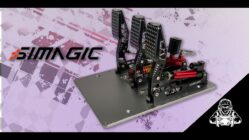
The overall design is fairly conventional and proven. You have individual pedals, a baseplate over them and a rubberised mat on top, an approach we’ve seen from brands including MOZA and Logitech. I actually like the rubber mat. It adds a little comfort compared with resting your heels directly on metal and, after weeks of use with both socks and shoes, mine showed very little wear.
Simagic has also thought about people who don’t yet have a dedicated aluminium-profile rig. There are feet intended to help on carpet and an optional bracket that can brace the pedal set against a wall or another solid object. That’s exactly the sort of consideration an entry-level product needs. Someone shouldn’t have to buy a full cockpit just because they’ve decided to upgrade their pedals.
I had no build-quality issues in normal use. My only minor assembly complaint was fitting the baseplate. Some of the small bolts were unusually tight and it felt as though the coating may have been a little thick around the threads. They needed more force than expected, but everything eventually fitted correctly and it wasn’t a serious installation problem.
Haptic motors: excellent upgrade, but watch the price
The optional haptic motors are good fun and give the P700 a useful upgrade path, but they change the value equation considerably. The basic three-pedal set is less than €300, putting it around Fanatec CSL Elite V2 territory. My configuration with haptics, however, comes to roughly €500. At that point there are considerably more alternatives worth considering.
If I were spending my own money, I’d prioritise a single haptic reactor on the brake. ABS feedback is the most useful effect. A second motor on the throttle is nice to have for effects such as traction control or gear shifts, and personally I’d probably spend the extra for it. I don’t see much need for a third motor on the clutch at this level. You also need the haptic power supply, although a single supply and the control box can accommodate the full setup.
The haptic effects themselves do the job, but they’re not the most refined solution I’ve used. Compared with something such as Simagic’s larger HPR-style back-and-forward movement or some third-party offset-weight solutions, the P700 motors feel a little more basic and ‘tinny’. They are still useful; just don’t mistake them for a reason to turn an inexpensive pedal set into a €500 purchase without considering the competition.
You can control the effects through Simagic’s own software without needing SimHub. It works well enough there, but I prefer SimHub because it gives me better control over the effects. I had no issues using the P700 haptics through SimHub during the review period.
P700 vs P500, P1000 and P2000
The P700 also changes how I look at Simagic’s own pedal range. I’ve said before that I really like the Simagic ecosystem but felt that the pedals could let it down. The P1000 is much more modular and is a lovely-looking pedal set, but I’ve had issues with its brake and I prefer the brake feel of the P700. That’s remarkable given where these sit in the range.
I still think the Simagic P2000 is a very good pedal set, although I’ve encountered some reliability concerns and I think it’s due a refresh. I’d like to see a future version take some of the best ideas from both the P1000 and P700. As for the P500, I struggle to see its place now. For me, the P700 is the obvious route into Simagic pedals.
How far can an entry-level pedal set really take you?
This is probably the most important point of the review. If we imagined the complete hardware experience of something like active pedals as 100%, I’d say the P700 can get you perhaps 60–70% of the way there in terms of the overall hardware experience. But when we’re talking about actual pace, these pedals could take many drivers 100% of the way to the limit of their talent. You cannot realistically blame the P700 for holding back your performance.
Spend €700, €800 or even €1,000 later and you can absolutely gain things: better materials, prettier construction, more sophisticated adjustment and a more luxurious ownership experience. What you may not necessarily gain is a better brake. That’s extremely high praise for a pedal set in this price bracket.
Final verdict
The Simagic P700 is now right at the top of my entry-level pedal recommendations alongside the Fanatec CSL Elite V2. The Conspit Apex hydraulic pedals are also worth considering if your budget stretches a little further, and I’ll be looking at alternatives such as the MOZA SR-P2 as well. But the P700 sets a very high bar.
It’s inexpensive, easy to assemble and adjust, works as a standalone USB pedal set whether you own other Simagic hardware or not, and gives you an upgrade path through haptics. Most importantly, it has a genuinely excellent brake. I went into this review wishing I had more faults to highlight, but after six to eight weeks of regular use, the limitations are small.
I can also see these holding their value reasonably well because the fundamentals are so good. You may eventually want something more premium, but you won’t need to replace the P700 simply because you’ve outgrown its braking performance. Simagic has done an excellent job here, and I can recommend these very highly.
If you choose to buy the P700 or any of the alternatives mentioned here, you’ll find my affiliate links and discount codes on the site. Using those links helps support the channel. As always, these conclusions are my own opinions based on using the hardware; they aren’t taken from Simagic’s marketing material or other reviews.


Add comment