
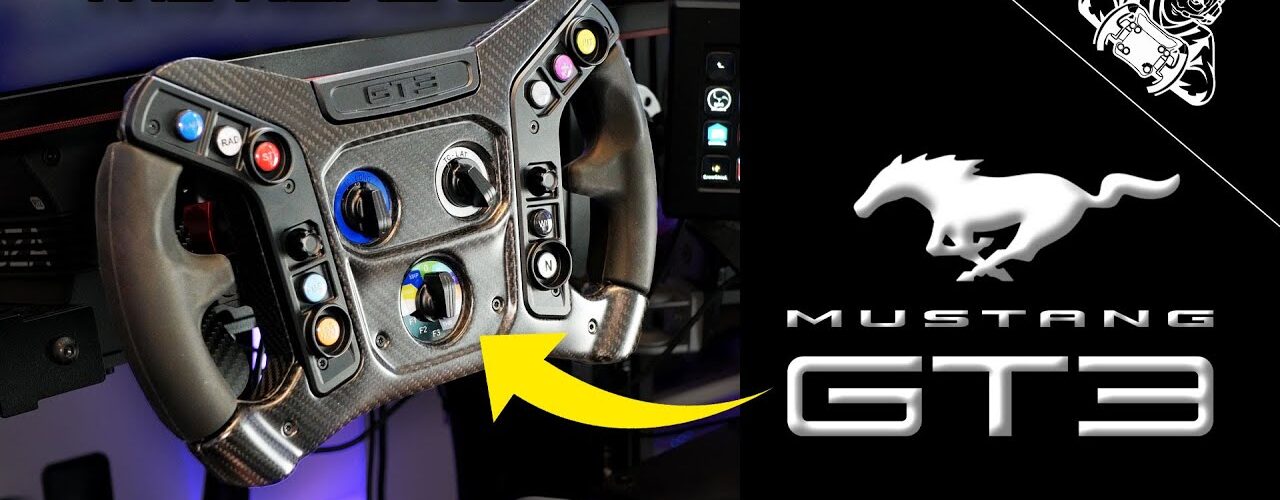
The VPG Ford Mustang GT3 is probably one of the most niche steering wheels I’ve ever had in the studio. It’s an officially licensed Ford product based on the real Mustang GT3 wheel, constructed from beautifully moulded carbon fibre and priced firmly in enthusiast territory.
After spending a week with it and using it in several competitive races, I came away with two conclusions that sound contradictory but really aren’t: this is quite possibly the best-made sim racing steering wheel I’ve ever seen, and it’s also not a wheel I would personally buy.
| Logo | Brands | Reseller | Discount Code | Link | Ships to | Locations |
|---|---|---|---|---|---|---|
 | Fanatec | Fanatec USA | https://laurencedusoswa.com/a/FANATEC-USA | America | Beverly Hills, California, USA | |
| Fanatec | Fanatec EU | https://laurencedusoswa.com/a/FANATEC-EU | EU | Landshut, Germany | |
| Fanatec | Fanatec Australia | https://laurencedusoswa.com/a/FANATEC-OZ | Australia | New South Wales, Australia | |
| Fanatec | Fanatec Japan | https://laurencedusoswa.com/a/FANATEC-JP | Japan | Tokyo, Japan | |
 | BDH, Conspit, Cube Controls, D-BOX, Heusinkveld, Logitech, MOZA, Pimax, Qubic System, Rexing, Simagic, Simucube, Trak Racer, VNM | Trak Racer USA | https://laurencedusoswa.com/a/TRAK-RACER-USA | America | Austin, Texas, USA | |
| BDH, Conspit, Cube Controls, D-BOX, Heusinkveld, Pimax, Qubic System, Rexing, Simagic, Simucube, Trak Racer, VNM | Trak Racer UK | https://laurencedusoswa.com/a/TRAK-RACER-UK | UK | Hertfordshire, England, UK | |
| BDH, Conspit, Cube Controls, D-BOX, Heusinkveld, MOZA, Pimax, Qubic System, Rexing, Simagic, Simucube, Trak Racer, VNM | Trak Racer EU | https://laurencedusoswa.com/a/TRAK-RACER-EU | EU | Venlo, The Netherlands | |
| BDH, BWT Alpine Formula One Team, Conspit, Cube Controls, D-BOX, Heusinkveld, Hot Wheels, Pimax, Qubic System, Rexing, Simagic, Simucube, Trak Racer, VNM | Trak Racer Australia | https://laurencedusoswa.com/a/TRAK-RACER-OZ | Australia | Victoria, Australia | |
 | Asetek | Asetek Global | 5% off with coupon code 'LD' | https://laurencedusoswa.com/a/ASETEK-GLOBAL | Global | Florida, USA. Aalborg, Denmark |
| Asetek | Asetek USA | 5% off with coupon code 'LD' | https://laurencedusoswa.com/a/ASETEK-USA | America | Florida, USA |
| Asetek | Asetek EU | 5% off with coupon code 'LD' | https://laurencedusoswa.com/a/ASETEK-EU | EU | Aalborg, Denmark |
 | Simagic | Simagic Direct | 3% off with coupon code 'LD' | https://laurencedusoswa.com/a/SIMAGIC | Global | Shenzhen, China, Asia |
 | Fanatec, GT Omega, HORI, Logitech G, MOZA Racing, Next Level Racing, Playseat, PXN, Thrustmaster, DIWANGUS | Amazon Global (will bring you to your local amazon store automatically) | https://laurencedusoswa.com/a/AMAZON | Global | ||
 | Apex Sim Racing, Cube Controls, D-BOX, Elgato, MOZA Racing, Pimax, Sabelt Sim Racing, Simagic, Simnet Racing, Simucube | Apex Sim Racing | 5% off with coupon code 'LD' | https://laurencedusoswa.com/a/APEX-SIM-RACING | Global | New Jersey, USA |
 | Advanced SimRacing, Ascher Racing, Base Performance Simulators, BavarianSimTec, BDH Race Sim Hardware, ButtKicker, Cube Controls, Daniel Newman Racing, D-BOX Technologies, Delta Sim-Tech, Gomez Sim Industries, Heusinkveld, IgnitiON Controls, Logitech, Max Papis Innovations, MME Motorsport, MOZA Racing, Novus Racing Simulators, P1Sim, Playseat, Precision Sim Engineering, Qubic System, Simucube, Sparco, Thrustmaster, Vero Motion, VNM Simulation, VPG Sim | Advanced Sim Racing | 5% off with code LDUSOSWAFIVE | https://laurencedusoswa.com/a/ASR | Global | Montreal, Canada |
 | Ascher Racing, ASUS, Base Performance Simulators, BDH Race Sim Hardware, ButtKicker, Cobra, Cube Controls, EPOS, Fanatec, Gigabyte, Go-Race, Gomez Sim Industries (GSI), Heusinkveld Engineering, ImSim, MME SimSport, MOZA, OBP, O-Rouge, Overclockers, Qubic System, Racelogic, Rexing, Sabelt Sim Racing, Samsung, Simucube, Simtag, Simtrecs, Sparco, Trak Racer, VPG Sim | Demon Tweeks | https://laurencedusoswa.com/a/DEMON-TWEEKS | Global | Wrexham, Wales, UK | |
 | bruzzi, ButtKicker, Conspit, Marina Racewear, MOZA Flight, MOZA Racing, Next Level Racing, Pro Simrig, Qubic System, Racing Sims, Sim Did, Simagic, Simetik, Simforge, Soelpec, Vero Motion | Abruzzi | https://laurencedusoswa.com/a/ABRUZZI | UK, EU | East-Sussex, England, UK | |
 | Streamlabs | Streamlabs | https://laurencedusoswa.com/a/STREAMLABS | Global | ||
| Restream | Restream | https://laurencedusoswa.com/a/RESTREAM | Global | |||
 | iRacing | iRacing | https://laurencedusoswa.com/a/IRACING | Global | Chelmsford, Massachusetts, USA | |
 | Coach Dave Delta | Coach Dave Academy | https://laurencedusoswa.com/a/CDA | Global | London, England, UK | |
 | Soelpec | Soelpec | https://laurencedusoswa.com/a/SOELPEC | Global | Istanbul, Turkey | |
 | Moza | Moza UK | https://laurencedusoswa.com/a/MOZA-UK | United Kingdom | UK | |
| Moza | Moza US | https://laurencedusoswa.com/a/MOZA-US | North & South America | USA | |
| Moza | Moza EU | https://laurencedusoswa.com/a/MOZA-EU | Global | Europe | |
| Moza | Moza Direct | https://laurencedusoswa.com/a/MOZA | Global | Shenzhen, China, Asia | |
 | Cobra, PRO SIMRIG, Qubic System, SIMAGIC, Sparco | RaceAnywhere | https://laurencedusoswa.com/a/RACE-ANYWHERE | UK, EU | Northamptonshire, UK | |
 | Grid Engineering, Sim-Lab, Sparco | Sim-Lab Direct | https://laurencedusoswa.com/a/SIM-LAB | Global | Tholen, The Netherlands, EU | |
 | Cammus | Cammus Direct | 5% off with code LDCAMMUS | https://laurencedusoswa.com/a/CAMMUS | Global | China, Asia |
 | Buttkicker | Buttkicker Direct | https://laurencedusoswa.com/a/BUTTKICKER | Global | Ohio, USA | |
 | Apex Sim Racing, Asetek SimSports, Gomez Sim Industries, Next Level Racing, SimSportGadget, Simtrecs, Simucube | SimRaceCity | 5% off with promocode: potato-nation | https://laurencedusoswa.com/a/SRC | USA | Fort Worth, Texas, USA |
 | Extreme Simracing, Simagic, D-BOX, DBOX | Extreme Simracing | https://laurencedusoswa.com/a/EXTREME-SIMRACING | America | Maringá, Paraná, Brazil | |
 | Ascher Racing, BavarianSimTec, SimRacingBay, Simucube | SimRacingBay | https://laurencedusoswa.com/a/SIMRACINGBAY | Global | Slovenia, EU | |
 | Simforge Engineering | Simforge Engineering | https://laurencedusoswa.com/a/SIMFORGE | Global | Chennai, India, ASIA | |
 | Website Hosting | HostGator | https://laurencedusoswa.com/a/HOST-GATOR | Global | USA | |
| RacGTing Racing Cockpits | RacGTing | https://laurencedusoswa.com/a/RACGTING | Global | Asia | ||
 | Getail Design | Getail Design | 5% off with coupon code 'LD' | https://laurencedusoswa.com/a/GETAIL | Global | Bergamo, Italy, EU |
 | Pimax | Pimax EU | https://laurencedusoswa.com/a/PIMAX-EU | EU | EU | |
| Pimax | Pimax | https://LaurenceDusoswa.com/a/PIMAX | Global | Shanghai , China | |
 | Asetek, Cube Controls, Fanatec, Sim Lab, Simagic | IRL Motorsports | https://laurencedusoswa.com/a/IRL-MOTORSPORTS | EU, UK | Dublin, Ireland | |
 | BDH | BDH Sim Hardware | https://laurencedusoswa.com/a/BDH | Global | Pocklington, York, UK | |
 | BDH, CAMMUS, Conspit, DOF Reality, Fanatec, Heusinkveld, MOZA Racing, PXN, Qubic System, Race Sim, Simnet Racing | RACESIM UK | 5% off with coupon code 'LD' | https://laurencedusoswa.com/a/RACESIMUK | UK, EU | London, UK |
 | Asetek SimSports, Conspit, Corbeau, Cube Controls, DOF Reality, Fanatec, Gomez Sim Industries (GSI), Heusinkveld, Leoxz, Moza, Sabelt, SIM HQ, Sim-Lab, Simagic, SRP, VRS | Simpatico Sim Shop | 5% off with coupon code 'POTATONATION' | https://laurencedusoswa.com/a/SIMPATICO | USA, Canada | Jacksonville FL, USA |
 | Conspit | iracesimulators | 10% off with code 'LD' | https://laurencedusoswa.com/a/IRACESIMULATORS | EU | Dublin, Ireland |
 | Bavarian Sim Tec | Bavarian Sim Tec | 5% off with coupon code LAURENCE-DUSOSWA | https://laurencedusoswa.com/a/BST | GLOBAL | Bavaria, Germany |
 | Advanced Sim Racing, Ascher Racing, D-Box Technologies, HandsOnPerformance, Heusinkveld, Moza, Novus, OMP, ProSimRig, Simagic, Sim Consultants, Simucube, Sparco, Vero Motion | Sim Consultants | 5% off Simagic with code 'LD' | https://laurencedusoswa.com/a/SIM-CONSULTANTS | EU, UK | Dublin, Ireland, EU |
 | Asetek SimSports, Conspit, Cooler Master, Cube Controls, Fanatec, Logitech, MOZA Racing, Next Level Racing, Nitro Concepts, noblechairs, Simucube, Thermaltake, Thrustmaster | Overclockers (UK & USA) | https://laurencedusoswa.com/A/OVERCLOCKERS | Global | UK, USA | |
 | Advanced Sim Racing, Ascher Racing, BDH, Conspit, Full Push, Moza, Next Level Racing, Novus, Thrustmaster, VPG Sim | Full Push | 5% off with code 'LD' | https://laurencedusoswa.com/A/FULLPUSH | Canada | Canada |
 | Simsonn | Simsonn | 8% off with code LAURENCEDUSOSWA | https://laurencedusoswa.com/A/SIMSONN | Global | Kington, Herefordshire, United Kingdom & China |
 | 3DRap, Another Way, Ascher Racing, Asetek SimSports, Bavarian SimTec, BDH Race Sim, Brook Raslution, ButtKicker, Circuit One, Conspit, Cooler Master, Cube Controls, D-BOX, Dayton Audio, Delta Sim-Tech, DOF Reality, Elgato, EPLAB, Esportsim, Fanatec, FatBlackCat, GSI, Heusinkveld, HORI, KGL Creation Lab, Leoxz, MME Motorsport, MOZA FlightSim, MOZA Racing, MPI, Next Level Racing, Nitro Concepts, Novus, OMP, O-Rouge, OPLite, P1Sim, Pimax, Playseat, Pro Flight Trainer, Prosimu, PXN, Qubic System, Res-Tech, Rexing, Sabelt, Sensit Haptics, SG Racing, Sim Factory, Sim-Lab, Sim Racing Studio, Simagic, Simforge, Simgrade, SimRep, SimRig, Simucube, Simufy, Simsonn, Simtrecs, SimXPro, Soelpec, Sparco, The Mech Cat, Thermaltake, Thrustmaster FlightSim, Thrustmaster SimRacing, Tillett, TORQ, TrackTime, Trak Racer, VERO Motion, VIRPIL Controls, Virtual Fly, VNM Simulation, VPG Sim, VRS, Wheel Stand Pro | Simufy | https://laurencedusoswa.com/A/SIMUFY | EU, Global | Granada, Spain, EU | |
 | AccuForce, Asetek, CAMMUS, Conspit, Elgato (Stream Deck), Fanatec, Gomez Sim Industries, Logitech, Moza, PXN, Simagic, Simucube, Thrustmaster, VNM, VRS, Virpil | Sim Sport Gadget | 5% off with coupon code 'LAURENCE' | https://laurencedusoswa.com/A/SIMSPORTGADGET | USA, Global | Newark, NJ, USA |
| Asetek Racing | Asetek Nordic | 5% off with coupon code 'LD' | https://laurencedusoswa.com/A/ASETEK-NORDIC | ||
 | UGREEN | UGREEN | https://laurencedusoswa.com/A/UGREEN | Global | EU | |
 | Honeycomb | Honeycomb | 10% discount with code LAURENCEDUSOSWA10 | https://laurencedusoswa.com/a/HONEYCOMB | Global | EU, USA |
The build quality is phenomenal
The first thing that struck me was the weight. Without a quick release fitted, the Mustang GT3 wheel is surprisingly light. The carbon fibre construction is exceptional: the weave, moulding and curved sections are on another level from almost anything I’ve seen from a sim racing manufacturer.
This particular wheel was a review unit that had already been passed between other reviewers, which actually gave me another useful data point. There were only tiny signs of wear despite the handling and repeated packing and unpacking you’d expect from a circulating review sample. The grips remained in excellent condition and the wheel still looked close to new.
The grips themselves have a slightly tacky feel and are extremely high quality. Ergonomically, the wheel accommodates different hand positions nicely, with plenty of open space around the grips. I have relatively small hands and found it very comfortable, but there’s room for larger hands and gloves too.
I’ve previously spent significant time with VPG hardware in my VPG Elemento Pro review, but the carbon construction of the Mustang GT3 is particularly special. From a manufacturing perspective, I have very little to criticise.
Real GT3 ergonomics don’t automatically make a better sim wheel
This is where the review gets interesting. The Mustang GT3 wheel is heavily influenced by the real racing hardware, but sim racers and real GT3 drivers have different jobs. In a real car, the driver has an engineering team and pit crew supporting them. In sim racing, we’re often adjusting our own ABS, traction control, brake bias and menus while driving.
VPG has made some concessions to that reality. The seven-way funky switches, for example, aren’t part of the real-life wheel as far as I’m aware. They’re useful additions, but I found them a little small and recessed, particularly while wearing gloves. The movement before they register doesn’t concern me much, but raising them slightly would make them easier to find by feel.
The more important omission for me is thumb rotaries. There is physical space around the grips where they could be extremely useful, and I missed having quick access to controls I regularly adjust during a race.
The centre rotary switches are my biggest frustration
The centre rotaries behave as multi-position switches rather than the conventional left/right encoders most sim racers are used to. Each physical position can register as its own input. That’s completely understandable in a real race car where individual positions might correspond to predefined engine maps or other settings, but it isn’t how I generally want to control a simulator.
In many sims, we simply want one click clockwise to increment a setting and one click anticlockwise to decrement it. Having a dozen discrete inputs can therefore feel like wasted real estate. One of the lower switches can change the behaviour of other controls, including the seven-way hats, so there is considerable functionality available, but getting to something as simple as an ABS or traction-control adjustment becomes more complicated than I’d like.
If those central controls could optionally behave as normal encoders, this would become a much more attractive generic GT3 sim racing wheel for me.
Shifters and clutch paddles
The main shifter paddles are huge and feel very good, although they’re definitely not the quietest paddles I’ve used. The clutch paddles sit above them rather than below, mirroring the real car. That’s something to be conscious of if muscle memory from another wheel has you reaching for an upper paddle to flash the lights or perform another secondary function: on this wheel, accidentally grabbing it means dipping the clutch.
The dual-clutch functionality itself works, including the ability to launch using either side, but configuring the bite point is unnecessarily cumbersome by modern sim racing standards. There is no dedicated VPG software application for this process. You enter a configuration mode on the wheel and increment or decrement the bite point through button presses while relying on on-screen feedback.
Once you learn the procedure it works, but at this price I want something more intuitive. Making adjustments on the start line isn’t something I’d particularly enjoy when the process involves button combinations, repeated clicks and long presses.
Lighting and SimHub
The wheel uses SimHub for its lighting and a profile is provided. The illuminated button caps are high quality and the lighting is quite effective in a darker room. The pit-limiter and headlight-flash effects are useful, and changing settings can trigger colour feedback such as red for a decrement and green for an increment.
But aesthetically the lighting looks old-school to me. That’s arguably authentic to a real racing steering wheel, and the physical wheel itself looks beautifully modern, but even at full brightness the LEDs aren’t particularly impressive in a bright room. There’s also no conventional rev-light strip because that information is displayed on the car’s DDU rather than the steering wheel in the real application.
None of this makes the lighting bad. It simply doesn’t give me the same polished visual experience as some modern sim-specific wheels. Something like the Cube Controls CSX3, for example, approaches the needs of a sim racer from a very different direction.
On track: extremely comfortable and genuinely competitive
I initially recorded first impressions of this wheel and wasn’t happy with them. The configuration had confused me and I felt the product deserved more than a rushed judgement, particularly when somebody could be considering spending around €1,700. So I kept it for another week and did several competitive races before reaching a conclusion.
Once driving, the ergonomics are excellent. It feels completely natural in a GT3 car and would also work well for prototypes or formula-style driving. I had some phenomenal races with it, was extremely consistent and actually finished higher than I often would.
I’m absolutely not claiming the steering wheel made me faster. It could easily be coincidence. But I was very comfortable and confident using it, and that’s worth mentioning because the physical driving experience is one of the strongest arguments in its favour.
Is it worth around €1,700?
This is where the intended buyer matters enormously. I don’t think the construction itself is cheap to reproduce. Curved, beautifully moulded carbon fibre at this standard is difficult and expensive to manufacture. If this were an unlicensed wheel around the €1,000-€1,200 level, the build quality alone would make the price much easier for me to understand.
The Ford and Mustang GT3 licensing, authenticity and collectability add another dimension. For somebody who owns a Mustang, follows the Mustang GT3 programme or races the car almost exclusively in a simulator, this isn’t merely an input device. It’s an officially licensed piece connected to the real racing car. I can easily imagine an enthusiast having one signed by a driver and displaying it as motorsport memorabilia.
I don’t personally have that emotional connection to the Mustang. I respect the car and I’ve completed competitive seasons driving the Mustang GT3, but I don’t have any desire to own one. That inevitably changes the value equation. The premium attached to the licence simply isn’t something I’d personally pay.
What I’d change for sim racers
- Make the centre rotary switches optionally behave as normal encoders. This is the biggest change I’d make.
- Add thumb rotaries. They’re incredibly useful for quick ABS, traction-control and other adjustments.
- Raise the seven-way hats slightly. They’re a little recessed and can be awkward with gloves.
- Provide a more intuitive software configuration experience. At this price, adjusting features such as clutch bite point through button combinations feels unnecessarily primitive.
- Improve lighting visibility in bright environments. The lighting works and looks good in the dark, but isn’t a standout feature during the day.
Final verdict
The VPG Ford Mustang GT3 wheel is absolutely impeccably made. The carbon fibre may be the best I’ve seen on a sim racing steering wheel, the ergonomics are excellent, the grips feel superb and I was extremely comfortable racing with it.
But replicating a real racing wheel exposes an interesting problem: authentic doesn’t necessarily mean optimal for sim racing. Real drivers and sim racers interact with their cars differently. The multi-position switches, lack of thumb rotaries, recessed funky switches and cumbersome clutch configuration all make this less intuitive than some wheels designed specifically around sim racing.
If you’re a Mustang GT3 enthusiast, Mustang owner or collector, those compromises may barely matter. You’re getting an extraordinary piece of officially licensed hardware that also happens to be an excellent steering wheel. If you’re simply shopping for the best €1,700 GT-style sim wheel, however, I’d want more sim-specific functionality for the money.
For me, it’s beautiful, fascinating and perhaps the best-manufactured steering wheel I’ve reviewed – but it’s not for me.
This wheel was supplied to me on loan as a circulating review unit. The opinions and conclusions here are my own.


Add comment