
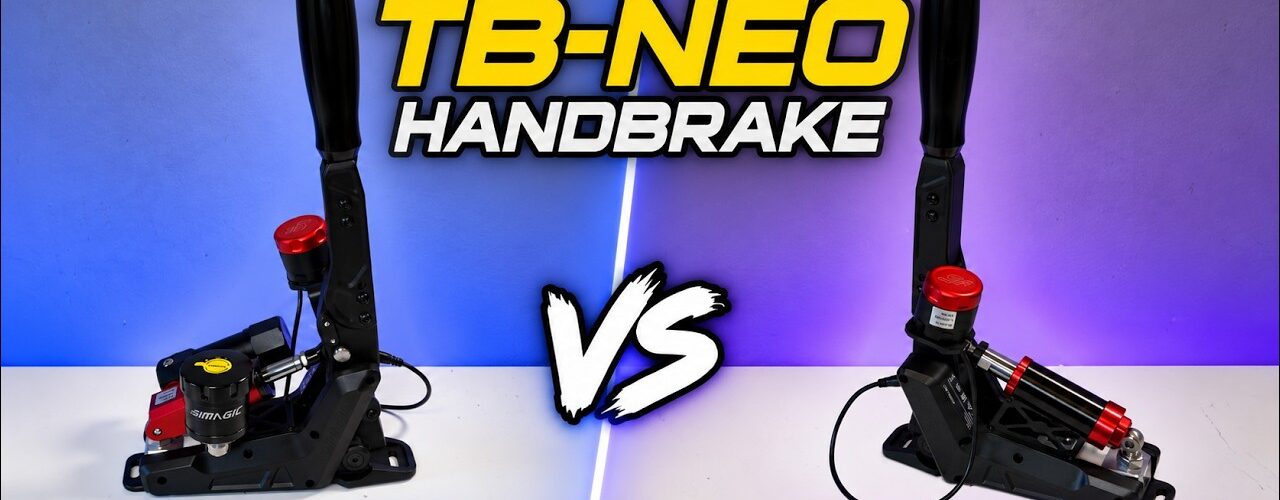
Simagic already had the TB-1 and the hydraulic TB-RS, so why introduce another handbrake? After spending a couple of weeks testing the TB-NEO in its standard, elastomer and hydraulic configurations, I think the answer is flexibility. This is a handbrake that starts at around $139/€139–€169 depending on your market, but can be upgraded considerably. The question is whether you should actually spend the money on those upgrades.
I’ve enjoyed using the TB-NEO in all sorts of configurations, and my favourite isn’t the most expensive. In fact, the standard non-hydraulic model with the right springs might be all the handbrake you’ll ever need.
1. What Is the Simagic TB-NEO?
The TB-NEO takes Simagic’s increasingly modular NEO approach and applies it to a load-cell handbrake. You can start with a relatively affordable mechanical setup, change the resistance using springs or elastomer pucks, add a hydraulic cylinder and even attach a haptic motor.
It could effectively cover the territory occupied by both the TB-1 and TB-RS, although I haven’t had confirmation that either older model is being discontinued. The attraction here is being able to start small and upgrade later rather than committing to the most expensive configuration from day one.
2. Unboxing, Build and Specifications
The packaging is typical Simagic: tidy presentation, clear instructions, branded bags and stickers. The box includes the handbrake, handle, mounting hardware, tools, cables and alternative elastomers. One small omission is a dedicated container for the spare elastomers, so you’ll want to keep the box handy.
- 100 kg load cell
- USB connection for standalone PC use
- CAN-FD connection for compatible Simagic wheelbases
- Separate power and connection ports for the optional haptic motor
- Top/profile and bottom-up mounting options
- Swappable spring and elastomer resistance elements
- Optional hydraulic and haptic upgrades
The 100 kg load cell is more than enough for my handbrake use. A higher load-cell rating might sound impressive on paper, but I wouldn’t treat 200 kg as an automatic advantage in a simulator. The TB-NEO also works independently over USB, so you don’t need a complete Simagic ecosystem. My testing was on PC; this isn’t a plug-and-play PlayStation or Xbox handbrake.
3. Installation and Mounting
Mounting was straightforward. The TB-NEO accommodates bolts down into profile T-nuts as well as bolts from underneath. The supplied handle has a shape I like, and even the standard mechanism felt promising during initial setup.
There is one ergonomic concern on my rig. The spring or elastomer chamber sits on the left side of the unit, and I prefer my handbrake close to the steering wheel, with the shifter slightly farther away. In that arrangement the protruding chamber pushes my shifter outward. It isn’t a deal-breaker, but it is worth checking the space around your shifter before buying, particularly if you have a tightly packed cockpit.
4. Standard TB-NEO: The Factory Springs
I always try to judge hardware in its factory configuration before experimenting with upgrades. Here, Simagic got the basics right. The two standard springs provide a natural, manageable pull that is light enough for frequent drifting without becoming tiring.
In Assetto Corsa I could comfortably control the rear of the car and make repeated handbrake corrections. I’m not drifting every day these days, but even when switching back to the default setup after the more expensive configurations, I had no trouble getting the car to do what I wanted.
If this were my first load-cell handbrake, I could be entirely happy with the standard setup. For my personal taste, though, those springs are a little on the light side. That is where the more interesting tuning options come in.
5. Elastomer Pucks Versus Springs
Switching the resistance stack is fairly simple: release the assembly, remove the springs and insert your chosen elastomer pucks. I tested the included black elastomers and could still drift and modulate the handbrake without any major change in calibration.
Functionally, the elastomers do the job. My objection is the feel. I consistently find these small rubber pucks less satisfying than springs, whether they’re in pedals or handbrakes. On the TB-NEO they made the pull feel a little more toy-like to me rather than more convincing. That’s a subjective preference, not evidence that you can’t drive well with them. You may love the resistance they offer.
For me, springs win this comparison comfortably.
6. Hydraulic Upgrade: Does It Feel Better?
I also tested the inverted hydraulic upgrade, which uses a hydraulic cylinder related to the one Simagic offers for the P1000 pedals. The kit includes further tuning components, including springs and elastomers, so it gives you more scope to adjust the handbrake than the basic package.
The hydraulic unit is well presented and feels substantial. In its more refined spring configuration, the TB-NEO becomes a noticeably more premium-feeling handbrake. There’s a satisfying, purposeful resistance to the pull and enough travel for precise application and release.
That precision matters even if a handbrake often appears to be an on/off control. When you’re drifting or rallying, how quickly you engage and release it—and how confidently you can repeat that movement—has a real influence on how comfortable you feel driving.
But here’s the catch: much of what I loved about my favourite hydraulic configuration came from the springs, not a dramatic difference created by the hydraulic system itself. Using comparable springs in the non-hydraulic mechanism felt surprisingly similar. That makes it difficult for me to recommend the expensive upgrade purely for driving feel.
7. My Favourite Configuration: Red and Blue Springs
My favourite setup used the red and blue springs from the P1000-related tuning kit. They provided the firmer, more convincing resistance I wanted while maintaining useful travel and control. It’s very close to a spring combination I’ve enjoyed previously with the P1000 hydraulic brake.
If I were spending my own money, I’d look at the standard non-hydraulic TB-NEO first, then investigate whether I could get that spring combination separately. I wouldn’t buy the entire hydraulic package just to obtain the springs without checking the options. Simagic’s upgrade path is excellent, but it doesn’t mean you need to follow it all the way to the top.
8. Haptic Motor: One Upgrade I’d Skip
The optional haptic motor is the easiest part of this review to summarise: I don’t like it on a handbrake. I felt the same about the haptics on the TB-RS. On my rig, the motor’s vibration is transmitted through the handbrake and its shifter mount, which are relatively far from my body. It adds little useful feedback and can become distracting.
I also don’t find vibration a particularly convincing representation of what happens when you lock the rear wheels. In my real-car experience, the sensation is generally smoother once the wheels are locked, not more vibratory. Other drivers may enjoy a configurable cue, but personally I’d leave this extra off my shopping list.
9. Software and Calibration
The load-cell readings were reliable throughout my testing once the TB-NEO was calibrated. I did have an unusual issue straight out of the box: initially the handbrake registered absolutely no input in the software, which made me think the unit was faulty.
Simagic suggested recalibration, and that fixed it immediately. I usually associate recalibration with correcting a range that’s slightly wrong, not bringing an apparently dead input back to life. If your TB-NEO shows no movement on first connection, try recalibrating it in Simagic’s software before assuming the hardware has failed.
After that initial issue, I didn’t encounter the erratic sensor readings that I’ve experienced with some other hardware in the past.
10. Value, Alternatives and Final Verdict
The TB-NEO is an excellent handbrake at its entry price. It has a good basic pull, useful adjustability, versatile mounting and connectivity, and the option to grow with your setup. Simagic has made something genuinely appealing here.
However, a fully upgraded TB-NEO with hydraulic hardware and haptics becomes a much more expensive proposition—potentially around €450 depending on your chosen configuration and local pricing. At that point, you should be comparing it against dedicated premium handbrakes rather than assuming the most heavily optioned TB-NEO must be the best.
I’ve used premium handbrakes from the likes of Heusinkveld and Hands On Performance that offer exceptionally satisfying resistance and feel. The TB-NEO doesn’t automatically beat those simply because you can bolt more accessories onto it.
My advice is simple: buy the base model, try the factory springs and included elastomers, and only upgrade if you discover something specific that you want to change. If you share my preference for a firmer spring-driven pull, the red-and-blue spring combination is the first improvement I’d investigate.
The TB-NEO is easy to recommend. Just don’t confuse having an upgrade path with needing every upgrade.
Watch the Review and Find Retailers
The video above includes driving footage and side-by-side impressions of the configurations I tested. For current retailers and affiliate options, see my sim racing affiliate directory. Affiliate links may earn me a commission, but they do not influence my independent opinions.








Add comment