
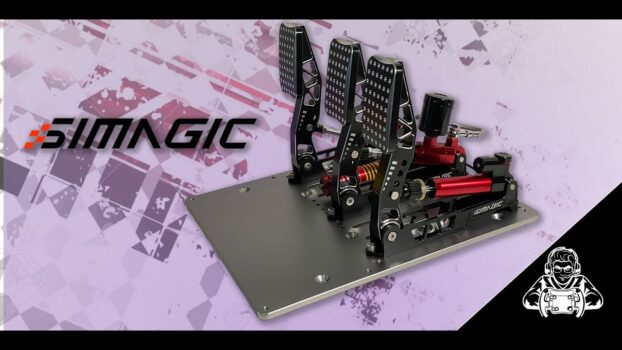
Simagic’s P2000 pedals arrived with high expectations after the company made its name with direct-drive wheelbases and its wider sim-racing ecosystem. This long-term review covers how the hydraulic pedals performed, how easy they were to install and tune, and the compromises I found along the way.
The review set was supplied by Simwear.eu, one of Europe’s largest Simagic stockists. The retailer had no editorial control over this review. You can also view the Simagic P2000 product page.
Quick verdict
The throttle and brake are outstanding and rank among the best I had used at the time of this April 2024 review. The hydraulic feel, effective software and accessible adjustments make the P2000 set easy to tune and rewarding to drive. The clutch is the weakest element: it initially felt noisy and clunky, although adding a deadzone in the software improved it considerably.
The main drawbacks on my review set were lateral play in the pedal arms, an awkward external control box, a long baseplate, limited fore-and-aft adjustment, and occasional fluid spill or wheezing from the reservoir breather. Simagic may have revised the hardware since this review, so check the current specification and reseller guidance before buying.
Product affiliate links & discounts
| Logo | Brands | Reseller | Discount Code | Link | Ships to | Locations |
|---|---|---|---|---|---|---|
 | Fanatec | Fanatec USA | https://laurencedusoswa.com/a/FANATEC-USA | America | Beverly Hills, California, USA | |
| Fanatec | Fanatec EU | https://laurencedusoswa.com/a/FANATEC-EU | EU | Landshut, Germany | |
| Fanatec | Fanatec Australia | https://laurencedusoswa.com/a/FANATEC-OZ | Australia | New South Wales, Australia | |
| Fanatec | Fanatec Japan | https://laurencedusoswa.com/a/FANATEC-JP | Japan | Tokyo, Japan | |
 | BDH, Conspit, Cube Controls, D-BOX, Heusinkveld, Logitech, MOZA, Pimax, Qubic System, Rexing, Simagic, Simucube, Trak Racer, VNM | Trak Racer USA | https://laurencedusoswa.com/a/TRAK-RACER-USA | America | Austin, Texas, USA | |
| BDH, Conspit, Cube Controls, D-BOX, Heusinkveld, Pimax, Qubic System, Rexing, Simagic, Simucube, Trak Racer, VNM | Trak Racer UK | https://laurencedusoswa.com/a/TRAK-RACER-UK | UK | Hertfordshire, England, UK | |
| BDH, Conspit, Cube Controls, D-BOX, Heusinkveld, MOZA, Pimax, Qubic System, Rexing, Simagic, Simucube, Trak Racer, VNM | Trak Racer EU | https://laurencedusoswa.com/a/TRAK-RACER-EU | EU | Venlo, The Netherlands | |
| BDH, BWT Alpine Formula One Team, Conspit, Cube Controls, D-BOX, Heusinkveld, Hot Wheels, Pimax, Qubic System, Rexing, Simagic, Simucube, Trak Racer, VNM | Trak Racer Australia | https://laurencedusoswa.com/a/TRAK-RACER-OZ | Australia | Victoria, Australia | |
 | Asetek | Asetek Global | 5% off with coupon code 'LD' | https://laurencedusoswa.com/a/ASETEK-GLOBAL | Global | Florida, USA. Aalborg, Denmark |
| Asetek | Asetek USA | 5% off with coupon code 'LD' | https://laurencedusoswa.com/a/ASETEK-USA | America | Florida, USA |
| Asetek | Asetek EU | 5% off with coupon code 'LD' | https://laurencedusoswa.com/a/ASETEK-EU | EU | Aalborg, Denmark |
 | Simagic | Simagic Direct | 3% off with coupon code 'LD' | https://laurencedusoswa.com/a/SIMAGIC | Global | Shenzhen, China, Asia |
 | Fanatec, GT Omega, HORI, Logitech G, MOZA Racing, Next Level Racing, Playseat, PXN, Thrustmaster, DIWANGUS | Amazon Global (will bring you to your local amazon store automatically) | https://laurencedusoswa.com/a/AMAZON | Global | ||
 | Apex Sim Racing, Cube Controls, D-BOX, Elgato, MOZA Racing, Pimax, Sabelt Sim Racing, Simagic, Simnet Racing, Simucube | Apex Sim Racing | 5% off with coupon code 'LD' | https://laurencedusoswa.com/a/APEX-SIM-RACING | Global | New Jersey, USA |
 | Advanced SimRacing, Ascher Racing, Base Performance Simulators, BavarianSimTec, BDH Race Sim Hardware, ButtKicker, Cube Controls, Daniel Newman Racing, D-BOX Technologies, Delta Sim-Tech, Gomez Sim Industries, Heusinkveld, IgnitiON Controls, Logitech, Max Papis Innovations, MME Motorsport, MOZA Racing, Novus Racing Simulators, P1Sim, Playseat, Precision Sim Engineering, Qubic System, Simucube, Sparco, Thrustmaster, Vero Motion, VNM Simulation, VPG Sim | Advanced Sim Racing | 5% off with code LDUSOSWAFIVE | https://laurencedusoswa.com/a/ASR | Global | Montreal, Canada |
 | Ascher Racing, ASUS, Base Performance Simulators, BDH Race Sim Hardware, ButtKicker, Cobra, Cube Controls, EPOS, Fanatec, Gigabyte, Go-Race, Gomez Sim Industries (GSI), Heusinkveld Engineering, ImSim, MME SimSport, MOZA, OBP, O-Rouge, Overclockers, Qubic System, Racelogic, Rexing, Sabelt Sim Racing, Samsung, Simucube, Simtag, Simtrecs, Sparco, Trak Racer, VPG Sim | Demon Tweeks | https://laurencedusoswa.com/a/DEMON-TWEEKS | Global | Wrexham, Wales, UK | |
 | bruzzi, ButtKicker, Conspit, Marina Racewear, MOZA Flight, MOZA Racing, Next Level Racing, Pro Simrig, Qubic System, Racing Sims, Sim Did, Simagic, Simetik, Simforge, Soelpec, Vero Motion | Abruzzi | https://laurencedusoswa.com/a/ABRUZZI | UK, EU | East-Sussex, England, UK | |
 | Streamlabs | Streamlabs | https://laurencedusoswa.com/a/STREAMLABS | Global | ||
| Restream | Restream | https://laurencedusoswa.com/a/RESTREAM | Global | |||
 | iRacing | iRacing | https://laurencedusoswa.com/a/IRACING | Global | Chelmsford, Massachusetts, USA | |
 | Coach Dave Delta | Coach Dave Academy | https://laurencedusoswa.com/a/CDA | Global | London, England, UK | |
 | Soelpec | Soelpec | https://laurencedusoswa.com/a/SOELPEC | Global | Istanbul, Turkey | |
 | Moza | Moza UK | https://laurencedusoswa.com/a/MOZA-UK | United Kingdom | UK | |
| Moza | Moza US | https://laurencedusoswa.com/a/MOZA-US | North & South America | USA | |
| Moza | Moza EU | https://laurencedusoswa.com/a/MOZA-EU | Global | Europe | |
| Moza | Moza Direct | https://laurencedusoswa.com/a/MOZA | Global | Shenzhen, China, Asia | |
 | Cobra, PRO SIMRIG, Qubic System, SIMAGIC, Sparco | RaceAnywhere | 5% off with coupon code 'LD' | https://laurencedusoswa.com/a/RACE-ANYWHERE | UK, EU | Northamptonshire, UK |
 | Grid Engineering, Sim-Lab, Sparco | Sim-Lab Direct | https://laurencedusoswa.com/a/SIM-LAB | Global | Tholen, The Netherlands, EU | |
 | Cammus | Cammus Direct | 5% off with code LDCAMMUS | https://laurencedusoswa.com/a/CAMMUS | Global | China, Asia |
 | Buttkicker | Buttkicker Direct | https://laurencedusoswa.com/a/BUTTKICKER | Global | Ohio, USA | |
 | Apex Sim Racing, Asetek SimSports, Gomez Sim Industries, Next Level Racing, SimSportGadget, Simtrecs, Simucube | SimRaceCity | 5% off with promocode: potato-nation | https://laurencedusoswa.com/a/SRC | USA | Fort Worth, Texas, USA |
 | Extreme Simracing, Simagic, D-BOX, DBOX | Extreme Simracing | https://laurencedusoswa.com/a/EXTREME-SIMRACING | America | Maringá, Paraná, Brazil | |
 | Ascher Racing, BavarianSimTec, SimRacingBay, Simucube | SimRacingBay | https://laurencedusoswa.com/a/SIMRACINGBAY | Global | Slovenia, EU | |
 | Simforge Engineering | Simforge Engineering | https://laurencedusoswa.com/a/SIMFORGE | Global | Chennai, India, ASIA | |
 | Website Hosting | HostGator | https://laurencedusoswa.com/a/HOST-GATOR | Global | USA | |
| RacGTing Racing Cockpits | RacGTing | https://laurencedusoswa.com/a/RACGTING | Global | Asia | ||
 | Getail Design | Getail Design | 5% off with coupon code 'LD' | https://laurencedusoswa.com/a/GETAIL | Global | Bergamo, Italy, EU |
 | Pimax | Pimax EU | https://laurencedusoswa.com/a/PIMAX-EU | EU | EU | |
| Pimax | Pimax | https://LaurenceDusoswa.com/a/PIMAX | Global | Shanghai , China | |
 | Asetek, Cube Controls, Fanatec, Sim Lab, Simagic | IRL Motorsports | https://laurencedusoswa.com/a/IRL-MOTORSPORTS | EU, UK | Dublin, Ireland | |
 | BDH | BDH Sim Hardware | https://laurencedusoswa.com/a/BDH | Global | Pocklington, York, UK | |
 | BDH, CAMMUS, Conspit, DOF Reality, Fanatec, Heusinkveld, MOZA Racing, PXN, Qubic System, Race Sim, Simnet Racing | RACESIM UK | 5% off with coupon code 'LD' | https://laurencedusoswa.com/a/RACESIMUK | UK, EU | London, UK |
 | Asetek SimSports, Conspit, Corbeau, Cube Controls, DOF Reality, Fanatec, Gomez Sim Industries (GSI), Heusinkveld, Leoxz, Moza, Sabelt, SIM HQ, Sim-Lab, Simagic, SRP, VRS | Simpatico Sim Shop | 5% off with coupon code 'POTATONATION' | https://laurencedusoswa.com/a/SIMPATICO | USA, Canada | Jacksonville FL, USA |
 | Conspit | iracesimulators | 10% off with code 'LD' | https://laurencedusoswa.com/a/IRACESIMULATORS | EU | Dublin, Ireland |
 | Bavarian Sim Tec | Bavarian Sim Tec | 5% off with coupon code LAURENCE-DUSOSWA | https://laurencedusoswa.com/a/BST | GLOBAL | Bavaria, Germany |
 | Advanced Sim Racing, Ascher Racing, D-Box Technologies, HandsOnPerformance, Heusinkveld, Moza, Novus, OMP, ProSimRig, Simagic, Sim Consultants, Simucube, Sparco, Vero Motion | Sim Consultants | 5% off Simagic with code 'LD' | https://laurencedusoswa.com/a/SIM-CONSULTANTS | EU, UK | Dublin, Ireland, EU |
 | Asetek SimSports, Conspit, Cooler Master, Cube Controls, Fanatec, Logitech, MOZA Racing, Next Level Racing, Nitro Concepts, noblechairs, Simucube, Thermaltake, Thrustmaster | Overclockers (UK & USA) | https://laurencedusoswa.com/A/OVERCLOCKERS | Global | UK, USA | |
 | Advanced Sim Racing, Ascher Racing, BDH, Conspit, Full Push, Moza, Next Level Racing, Novus, Thrustmaster, VPG Sim | Full Push | 5% off with code 'LD' | https://laurencedusoswa.com/A/FULLPUSH | Canada | Canada |
 | Simsonn | Simsonn | 8% off with code LAURENCEDUSOSWA | https://laurencedusoswa.com/A/SIMSONN | Global | Kington, Herefordshire, United Kingdom & China |
 | 3DRap, Another Way, Ascher Racing, Asetek SimSports, Bavarian SimTec, BDH Race Sim, Brook Raslution, ButtKicker, Circuit One, Conspit, Cooler Master, Cube Controls, D-BOX, Dayton Audio, Delta Sim-Tech, DOF Reality, Elgato, EPLAB, Esportsim, Fanatec, FatBlackCat, GSI, Heusinkveld, HORI, KGL Creation Lab, Leoxz, MME Motorsport, MOZA FlightSim, MOZA Racing, MPI, Next Level Racing, Nitro Concepts, Novus, OMP, O-Rouge, OPLite, P1Sim, Pimax, Playseat, Pro Flight Trainer, Prosimu, PXN, Qubic System, Res-Tech, Rexing, Sabelt, Sensit Haptics, SG Racing, Sim Factory, Sim-Lab, Sim Racing Studio, Simagic, Simforge, Simgrade, SimRep, SimRig, Simucube, Simufy, Simsonn, Simtrecs, SimXPro, Soelpec, Sparco, The Mech Cat, Thermaltake, Thrustmaster FlightSim, Thrustmaster SimRacing, Tillett, TORQ, TrackTime, Trak Racer, VERO Motion, VIRPIL Controls, Virtual Fly, VNM Simulation, VPG Sim, VRS, Wheel Stand Pro | Simufy | https://laurencedusoswa.com/A/SIMUFY | EU, Global | Granada, Spain, EU | |
 | AccuForce, Asetek, CAMMUS, Conspit, Elgato (Stream Deck), Fanatec, Gomez Sim Industries, Logitech, Moza, PXN, Simagic, Simucube, Thrustmaster, VNM, VRS, Virpil | Sim Sport Gadget | 5% off with coupon code 'LAURENCE' | https://laurencedusoswa.com/A/SIMSPORTGADGET | USA, Global | Newark, NJ, USA |
| Asetek Racing | Asetek Nordic | 5% off with coupon code 'LD' | https://laurencedusoswa.com/A/ASETEK-NORDIC | ||
 | UGREEN | UGREEN | https://laurencedusoswa.com/A/UGREEN | Global | EU | |
 | Honeycomb | Honeycomb | 10% discount with code LAURENCEDUSOSWA10 | https://laurencedusoswa.com/a/HONEYCOMB | Global | EU, USA |
In this review
- Introduction
- First impressions
- Price and options
- Hardware installation
- Software and calibration
- Throttle
- Clutch
- Brake
- Baseplate
- Final thoughts
Introduction
When the P2000 pedals were announced in 2020, Simagic was still a relatively new name in direct-drive hardware. By the time I tested this set, the company had expanded into wheelbases, wheels, shifters and pedals. Building an ecosystem that matches the standard of the products that established a brand is difficult, so I was keen to see whether the P2000 lived up to that reputation.
First impressions
These pedals look stunning. The machining, minimalist shapes and diamond-cut pedal faces give them a distinctive finish, while the bright colours and reflective surfaces add personality. That styling will not suit everyone, but the set looks purposeful and is relatively easy to keep clean.
The pedal faces are comfortable with or without shoes and provide a good balance between grip and slip. Their height is adjustable, although they may not go as low as users with smaller feet would prefer. The throttle and clutch faces cannot be moved sideways independently, but each complete pedal is held to the rigid baseplate by two accessible bolts, making lateral repositioning straightforward.
My review set had slight lateral movement in all three pedal arms. It did not affect me while driving and was not caused by the two-bolt mounting arrangement; it appeared to come from clearance within the mechanisms. At the time, user reports varied, and I understood that later batches might have received a revised mechanism. Treat this as an observation about the set I tested in April 2024 rather than a claim about current production.
The hydraulic brake feels subtly different from a conventional non-hydraulic pedal, particularly when using more travel. Its movement and return feel slightly damped and predictable, which can improve confidence and control rather than making the brake feel like an on/off switch.
The pedals felt intuitive from my first drive. I had no calibration or compatibility problems in the simulators I tried, and the software was a welcome surprise. The baseplate is simple and rigid, with plenty of lateral mounting positions, though there is very little fore-and-aft adjustment.
The reservoir, spring assembly and braided hose form a tidy, compact system designed specifically for sim racing. It looks like a finished product rather than a DIY hydraulic conversion.
Price and options
When reviewed in April 2024, the P2000 three-pedal set started at €799 in Europe and around $780 in the United States. Those are historical prices, so check current pricing and availability with Simwear.eu or another authorised reseller.
My review set was the base 100 kg load-cell version. At the time, the 200 kg sensor cost an additional €50. The 100 kg sensor was enough for me even though I could reach its full range; for most of the racing I did, I rarely needed maximum braking force. A 200 kg sensor may still make sense for drivers who want to match a particularly heavy real-world pedal.
Other available options included a longer throttle pedal and a raised carbon heel plate. I did not test either accessory. The longer throttle looked useful for comfort and heel-and-toe driving, while the heel plate could bring smaller feet closer to the pedal faces.
Hardware installation
Installation was straightforward. The pedals arrived assembled apart from their faceplates, and each pedal required two bolts to mount to the baseplate. The loads applied in normal use are not primarily lateral, so the two-bolt mounting arrangement caused no problem in my testing.
The baseplate provides four lateral positions for the throttle, four for the clutch and seven for the brake. Separate holes make alignment simple and keep the assembly rigid, but they do not let you move an individual pedal closer to or farther from the seat.
A small bracket lets you tuck the hydraulic cylinder out of the way. Simagic also showed a vertical mounting option, which I tried without noticing a functional difference. Follow the current manufacturer instructions when positioning the reservoir and cylinder.
Eight mounting holes make the baseplate easy to fit to a profile rig. It is extremely strong, although it extends farther forward than I expected and may complicate installation on some rigs.
The external control box feels visually disconnected from the otherwise clean design. It is easy enough to hide and straightforward to replace, but its bright green LED can illuminate the floor beneath the rig.
Software and calibration
The standalone P2000 software was the biggest surprise. Calibration was simple, and I saw no signal fluctuations or calibration drift after the initial setup. At the time of testing, it was separate from Simagic’s wheelbase software and did not need to remain open unless I was actively changing settings.
High-end pedals are sensitive and highly configurable, which can make setup intimidating. The clear calibration and response-curve controls made the P2000 much more approachable. Software can change over time, so this describes the package I used during the April 2024 review.
Throttle
The throttle is excellent. Its travel is adjustable, and the bolt should be tightened after setting the desired throw. Moving the piston attachment among four heights provides further control over travel and weight; unexpectedly, I preferred the lowest setting.
The damper adjustment is especially effective and makes the throttle weight easy to change. Very high settings can slow both pedal movement and return, but setting four felt fantastic to me. Smooth, controllable throttle input matters in cars that are sensitive to traction, and this pedal exceeded my expectations. At the time, it went straight to the top of my list of throttles.
I would still consider the longer throttle option for extra comfort, particularly for heel-and-toe driving.
Clutch
The clutch uses an unusual mechanism in which a bolt passes through a notch to simulate the bite point, with four spring options available. It looks innovative, but its default feel disappointed me. The mechanism was not as subtle or engaging as I wanted, and the end of its travel produced a noticeable clunk.
After experimenting with the software, I added a deadzone around clutch engagement and the pedal improved considerably. It then felt more like a heavy road-car clutch. I would still prefer a bump stop at the end of the travel, but careful tuning turned an initially frustrating pedal into a usable and enjoyable one.
Brake
A hydraulic brake carries high expectations. The P2000 uses springs rather than elastomers and measures force with a load cell rather than a hydraulic pressure sensor. Neither choice created a noticeable disadvantage in my testing. The supplied spring combinations let me create both a softer, longer-travel road-car feel and the short, stiff setup I prefer.
With the stiffer configuration, the brake felt predictable across every simulator and car I tried. After locking the wheels, it was easy to remember the force at which it happened. Combined with the throttle, that consistency made the set very compelling.
A softer setup makes the hydraulic character more obvious because there is more travel and fluid movement to feel. With a very stiff setup, I am not sure I could reliably distinguish it from a strong high-end non-hydraulic pedal.
The 100 kg load cell performed as well as heavier sensors I had used. In my view, the 200 kg option was unnecessary for most people, though it remained useful for drivers who genuinely wanted more range.
The brake face includes extra rear mounting holes, although moving the complete pedal was already easy. The brake springs could also make noise when they were not seated correctly; as with other mechanical pedal sets, correct assembly and suitable maintenance matter.
Baseplate
The one-piece metal baseplate is thick, sturdy and requires no assembly. It provides enough mounting holes for most profile rigs and offers four throttle positions, four clutch positions and seven brake positions.
Its main limitations are the lack of fore-and-aft adjustment and its overall length. Neither stopped me using the pedals, but both are worth checking against your rig. The optional carbon heel plate may improve ergonomics for some users, though I did not test it.
Final thoughts
The P2000 largely met my high expectations. The throttle and brake are exceptional and, as a pair, ranked among the best I had used. Adjustments are almost tool-free and approachable, even if the total range of mechanical adjustment is smaller than on some competing sets.
The clutch is the weak link. Its stock configuration felt noisy and clunky, but software deadzone tuning made it much better. The longer throttle option may also improve heel-and-toe comfort. Whichever configuration you choose, tighten the pedal faces carefully after installation; one of mine came loose during a race.
The control box is awkward, but it can be hidden and would be easy to replace. I would prefer its electronics to be integrated into the baseplate or a pedal assembly, along with a less intrusive status light.
The reservoir breather occasionally wheezed with softer spring setups and could splutter when the pedals were moved. I experienced a small amount of fluid spilling from the breather, although I found no leaks elsewhere. Follow Simagic’s current handling guidance, keep the assembly in the recommended orientation and protect surrounding surfaces when moving or servicing the pedals.
My review set also had lateral play in the pedal arms, and there were reports of throttle issues around the review period. Reseller support was reported to be good, and I understood that later pedal revisions might have addressed the movement I experienced. Because designs and quality-control processes can change, confirm the current version and warranty support with an authorised reseller.
The software elevates an already strong set. I would like a quieter, more refined clutch, an integrated control box, an adjustable heel plate and a slightly shorter baseplate. Even with those criticisms, the P2000 pedals were intuitive to set up, beautiful to look at and excellent to drive.



Add comment